
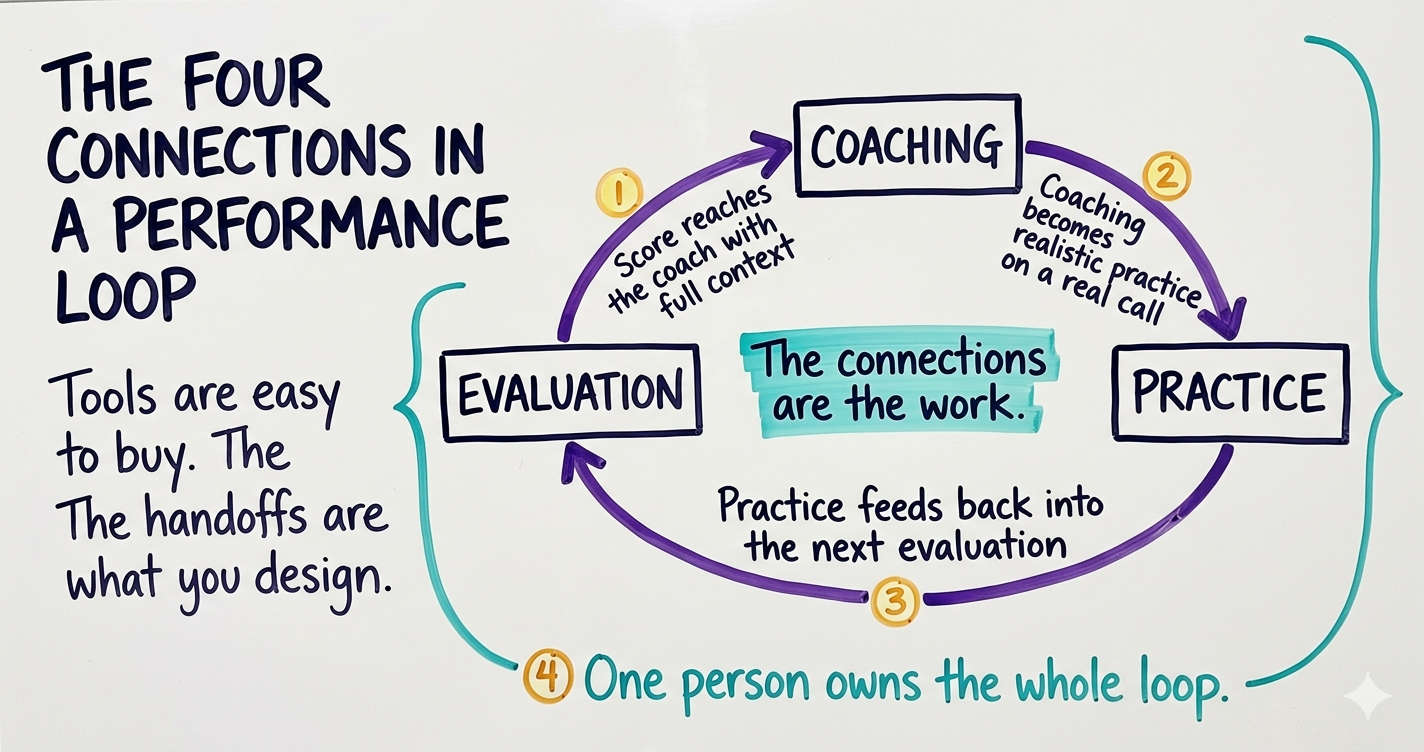
Most operations build a performance program by buying capable tools. A QA platform to score calls. A coaching system to track sessions. An LMS to run courses. Each one works on its own, and the assumption is that good tools in each box add up to a working loop.
They do not. Buying the tools is the easy part. What makes them work as a loop is how each one connects to the next and connecting them is the part you have to design.
That design is what separates a program where agents actually improve from one that just measures them. Here are the four ways to get right.
Connect the evaluation to the coaching
A score is only useful if it reaches the coach with its context intact. Design the handoff so the insight the evaluation found arrives at the session ready to use, not buried in a report the coach has to mine.
The goal is a coach who walks into the session already knowing what to work on and why, so the time goes to fixing the behavior instead of hunting for it.
Connect the coaching to the practice
Naming a behavior to fix is half the work. The agent needs somewhere to build that behavior before the next live call, and the practice has to mirror the real conversation, not a generic exercise that lets them go through the motions without showing competency.
Design the path from the session to targeted practice on the exact behavior the coach identified, in a scenario that matches what the agent actually faces. The behavior named in coaching and the repetition that proves they can execute it should be one continuous motion.
A coaching session that ends in realistic, behavior-specific practice is the difference between feedback that fades and feedback the agent can demonstrate on the next call.
Connect the practice back to the evaluation
Practice is only worth measuring if you can see whether it moved the behavior on a real call. Design the loop to close, so completed simulations and courses feed back into the next round of scoring.
That connection is what lets you answer the question the whole program exists to answer, which is whether the work changed the outcome. Without it you can prove an agent practiced and never prove it mattered.
Own the loop as one thing
The first three connections only hold if someone owns the whole circuit, not just the boxes. Assign ownership to the loop itself, not to three separate tools that each report on their own stage.
The connections between stages are invisible on any single dashboard, so they survive only when one person is accountable for the flow from score to coaching to practice and back. A handoff no one owns is a handoff that quietly disappears.
The reason this matters is simple. Behavior changes in the connections, not in the stages. The most accurate scorecard, the sharpest coaching, and the most realistic simulation still produce a slow program if the insight cannot move between them.
When you design the loop, spend your attention on the transfer points. That is where a feedback loop is won or lost.
This is what FiveLumens does by design. Evaluation, coaching, and practice live in one system, so the connections are not something anyone has to maintain. The score links to the coaching form with its context intact. The session assigns the practice. The practice feeds the next evaluation.
The loop is owned because it is one thing instead of three tools and the hope that they talk to each other.
A good performance program is not a collection of good tools. It is a set of deliberate connections. The tools tell you what is happening at each stage. The connections are what turn a sequence of stages into a loop that actually compounds.