
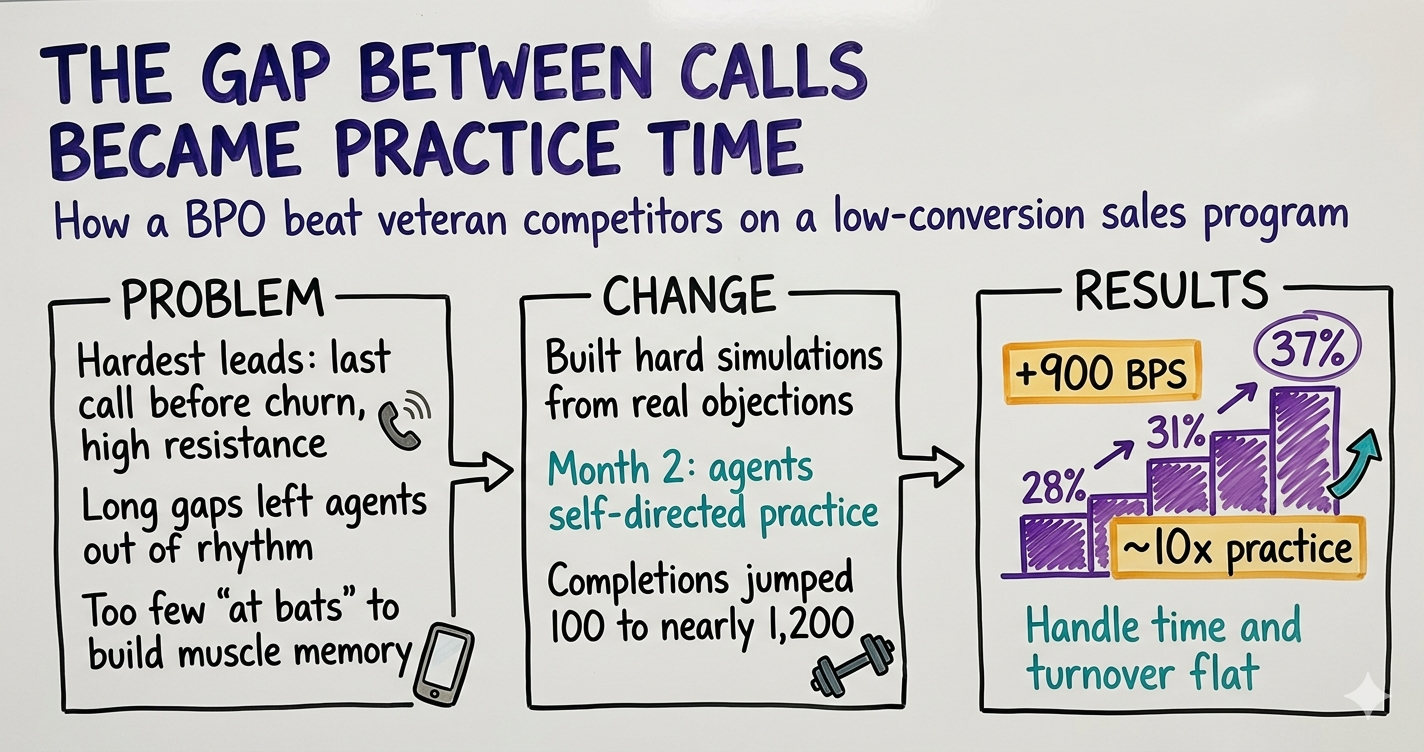
A BPO partner engaged FiveLumens to establish competitive performance on a new home services sales program against mature contact center operations. Their client had brought on a dedicated sales team, but the leads were customers who had not yet converted through prior channels. The remaining pool carried higher resistance, lower contact rates, and longer gaps between attempts.
The incumbent BPO partners had years of operational refinement behind them. They had already solved for the structural challenges of this lead pool. The team had a short ramp period to stand up the operation, after which they were expected to perform at parity. Early modifications to the sales methodology led to marginal improvements. The core challenge remained: building agent proficiency at scale in an environment where contact volume alone could not drive skill development fast enough.
The Context:
The lead pool itself was inherently constrained. These were customers who had already declined to renew through every other channel. The ones who wanted to convert had already converted. It was the last call before churn. That meant the contact rate was low, the resistance was high, and long gaps between calls left agents sitting idle for extended periods. When the call arrived, agents were out of rhythm and needed time to re-engage. The competitive pressure was clear: figure out how to build agent proficiency using a lead pool that was structurally designed to produce low conversion.
The Problem:
The BPO partner had already refined the sales methodology, and the organization was aligned to it. Training, quality assurance, and operations all pointed back to the same standard. That work was necessary, but it did not solve the fundamental constraint.
Long periods between calls left agents out of rhythm when contacts did arrive. They were not getting enough repetitions to build the muscle memory needed to execute the pitch with consistency and speed. In sales, proficiency comes from “at bats”. The more chances an agent gets to pitch, handle objections, and close, the sharper their instincts become. Their agents were getting a fraction of the repetitions they needed. By the time a live call came through, they had to reorient before they could perform. The methodology was sound. The practice volume was not.
The Change:
The plan was to close the gap between live contacts by giving agents realistic practice opportunities that the lead volume could not provide.
The BPO partner’s leadership went back to the calls and mapped every objection agents were facing, categorizing them by frequency. From that analysis, the most common resistance patterns became the foundation for FiveLumens simulation personas built around each one. The simulations were designed to be hard. They matched the difficulty of actual renewal calls, which meant agents had to attempt each FiveLumens simulation as many times as needed before they could successfully convert the persona. Practice felt like the real thing.
The first month served as a controlled rollout. This was intentional: the team needed to test, modify, and optimize the FiveLumens simulations before scaling. In the second month, they opened them up and let agents determine their own learning path. They could choose which personas to practice against and how often.
The shift in engagement was immediate. Simulation completions jumped from just over 100 in the first month to nearly 1,200 in the second.
The Results:
Big Numbers:
Baseline conversion rate was approximately 28%. After the first month with structured FiveLumens simulations, conversion lifted to 31%, almost a 300-basis point gain. When structure was removed and agents could self-direct their practice in month two, simulation completions jumped from just over 100 to nearly 1,200. Conversion climbed to 37%, a 600-basis point gain from the first month’s result. The number of simulations dropped after that, but conversion did not.
Hidden Wins:
The system proved that practice volume directly drove conversion lift. Agents who practiced more converted at higher rates than those who practiced less. The correlation was consistent across the team. Autonomy outperformed mandate-driven practice. Once agents had freedom to choose when and how to practice, engagement increased by nearly ten times without any additional operational pressure. Handle time and turnover remained flat, which confirmed the conversion gains did not come at the cost of speed or stability. The FiveLumens simulation system removed the structural constraint that had limited agent development from the start. The gap between live contacts was no longer dead time. It became practice time.