
A BPO partner needed to reduce time to proficiency for new hire contact center agents after they started taking live calls. Clients needed new hires productive fast. Whether scaling or backfilling attrition, the expectation was the same: every live call was a customer interaction, and agents ramping slowly meant wasted calls, inconsistent experiences, and extended underperformance across the metrics that mattered.
The cost was not financial. The cost was opportunity. Proficiency meant hitting targets across nine key metrics: calls per hour, customer satisfaction, QA scores, and others that defined agent effectiveness. The goal was not to shorten the training calendar. The goal was to ensure agents arrived at full performance faster once they were on the phones.
The Context
The BPO partner engaged FiveLumens to test a hypothesis: if AI-driven simulations replaced traditional training methods, agents could reach proficiency faster. They had two training classes of 20 agents each scheduled for a two-week onboarding program. Both groups were transitioning from one line of business to another.
The existing training model relied on PowerPoints, LMS learning paths, and traditional role plays. Agents spent most of their time in passive learning: lecture, reading, watching demonstrations. The training was built around memorization and checking boxes, not building skills. In the classroom, one trainer could only role play with one agent at a time. Most agents sat idle or watched others practice. When they did participate, the role plays happened in front of large groups, which created anxiety and reduced the quality of the practice.
By the time agents reached nesting, taking live calls under the supervision of a dedicated training team leader, they were underprepared. The real skill development happened on live customer calls, which extended ramp time and created inconsistent customer experiences.
The Problem
The constraint was not the content or the trainers. The constraint was the delivery method. Traditional training could not create enough realistic practice at scale.
One trainer working with one agent at a time meant 19 agents sat idle while one practiced. The role plays themselves were not realistic. They were scripted exercises between two people who both knew it was fake. There was no mechanism for immediate correction. Agents made mistakes, the trainer moved to the next person, and those same mistakes carried into live calls days later.
Generative AI changed the math. FiveLumens simulations could replicate real call scenarios, give agents unlimited practice without waiting for a trainer, and provide immediate feedback so agents could correct mistakes in real time before they ever reached a customer.
The Change
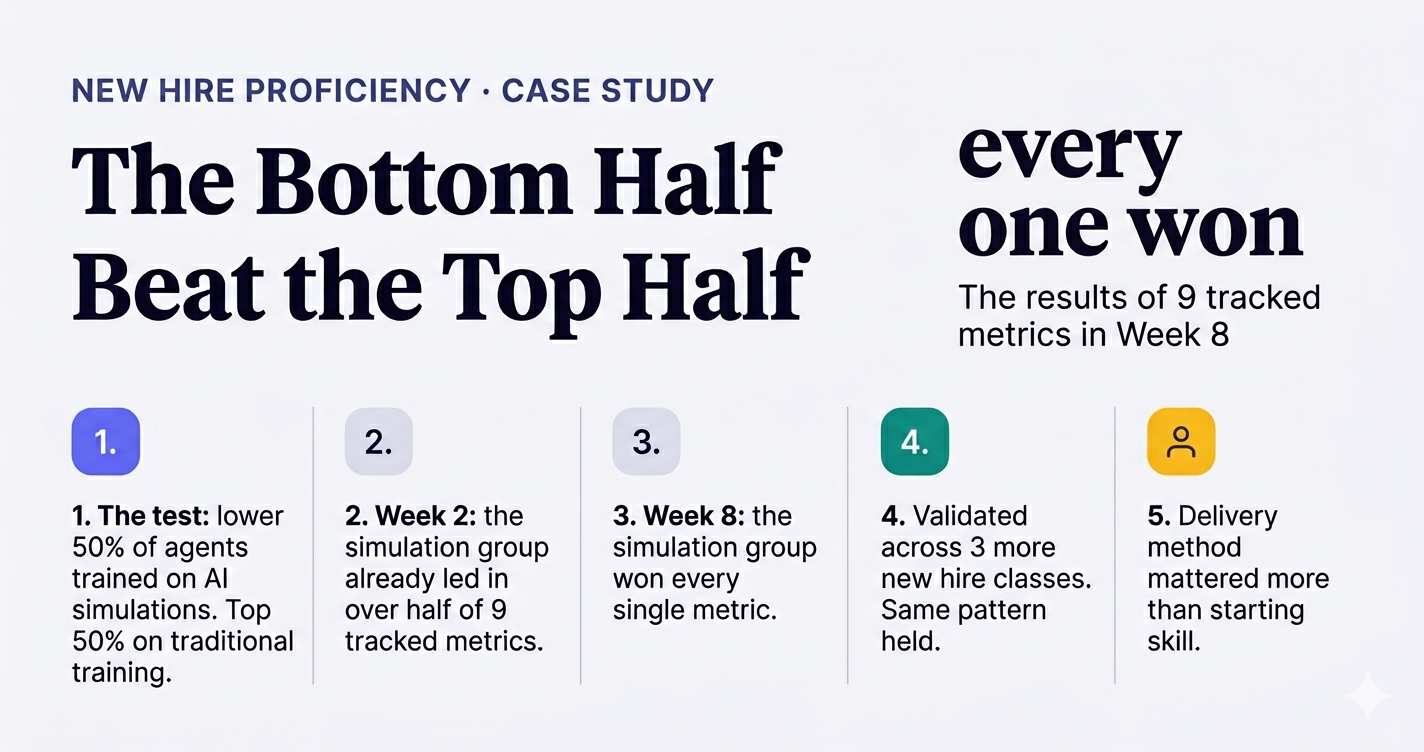
The team divided the two training classes by performance. The top 50% ran through traditional training as the control group. The lower 50% became the test group for FiveLumens simulations. This gave them a clear comparison between methods using agents who were already differentiated by baseline performance.
Leadership facilitated the collaboration between training, operations, and the client to review the entire curriculum and identify the critical behaviors agents needed to practice. The client added behaviors the team had not considered. This became the simulation blueprint. Each FiveLumens simulation replicated a real call scenario, not a scripted role play. The training team, agents, and client all tested and iterated on the simulations until they matched real conditions.
All traditional role plays in the lower performing class were replaced with FiveLumens simulations. Agents practiced on their own time, as many reps as they needed, with immediate feedback after every interaction. They could see what they did wrong, correct it, and try again without waiting for a trainer or performing in front of a group.
The Results
Big Numbers:
The team tracked nine key metrics the client used to rank every BPO partner. By week two, the lower performing group trained with FiveLumens simulations exceeded the higher performing control group in over 50% of those metrics. By week eight, they were outperforming the control group in every metric. The delivery method mattered more than the starting skill level. The results were validated with three additional new hire classes. The same pattern held. At that point, they stopped testing and moved to rollout.
Hidden Wins:
The simulations removed the performance anxiety that came with practicing in front of large groups. Agents practiced in a non-judgmental environment where mistakes carried no social cost. The practice was customized. Agents who struggled with specific behaviors could target those areas without sitting through irrelevant content. The feedback loop was immediate, which created a continuous improvement cycle that traditional training could not replicate. Agents arrived at live calls with muscle memory built, not theory memorized.