
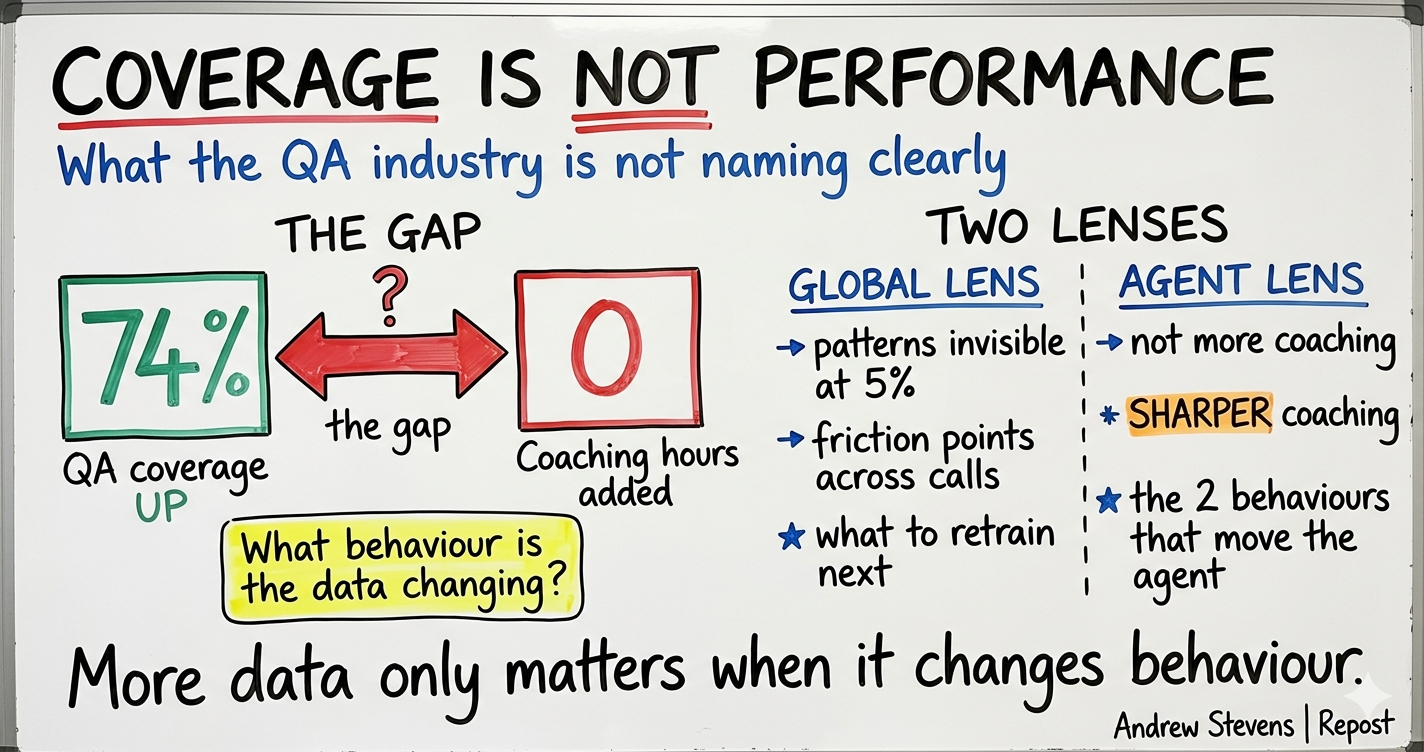
The QA industry is publishing a number that sounds like progress. According to Scorebuddy's recent QA and CX research, 74% of contact centers increased their QA coverage in the last three months, and 27% reported a significant increase. Scorebuddy's research is solid. The numbers are real. The question is what the industry is doing with them.
Coverage is a measurement metric. Performance is a behavior metric. They are not the same thing, and conflating them can be a serious problem.
The pitch for expanded coverage is clean. AI can now evaluate every interaction. Manual sampling missed too much. Broader coverage means better visibility, better consistency, and better customer outcomes. The logic holds until you ask the next question.
What happens with the data?
More data does not make coaching better. The same research notes that 85% of professionals agree coaching is the most effective way to improve performance. Coverage expanded. Coaching did not. A supervisor with 12 agents did not gain coaching hours when QA volume tripled. A QA team that scored 5% of calls and now scores 100% did not get a proportional increase in the time available to act on what they found.
The result is predictable. More flags, more dashboards, more scored interactions, and roughly the same behavior on the floor. The data accumulates faster than the organization can metabolize it.
This is what most operators are not naming clearly. Expanded coverage without an expanded mechanism to act on the coverage is collection for its own sake. It looks like rigor. It feels like progress. It produces almost nothing in performance terms.
The better frame for evaluating QA expansion is to ask what behavior the data is changing. There are two legitimate answers, and both have to be present for the investment to be worth defending.
The first is the global lens. Expanded coverage should reveal patterns that were invisible at 5% sampling. Friction points showing up across hundreds of interactions. Customer effort spiking in specific call types. Strengths concentrated in certain agents or teams that the rest of the operation can learn from. This view changes what leaders prioritize, what gets retrained, what the QA scorecard measures next quarter. It is structural and it improves the operation over time.
The second is the agent lens. Expanded coverage should produce sharper, more specific coaching for individual agents. Not more coaching sessions, since the hours did not change. Better coaching sessions, because the supervisor walks in knowing exactly which two behaviors will move the agent's performance, supported by evidence the agent recognizes. This view changes what one person does on their next call.
If the data is not driving either of those two outcomes, the coverage number is a vanity metric. It tells leadership the QA program is mature. It does not tell them whether the program is producing better conversations with customers.
The question to ask of any QA expansion is direct. What is different about how this operation runs because we now see more? If the honest answer is that dashboards are richer and reports are longer, the investment is funding measurement, not improvement. More data is only useful when it changes behavior. Otherwise it is collection because collection is possible.