
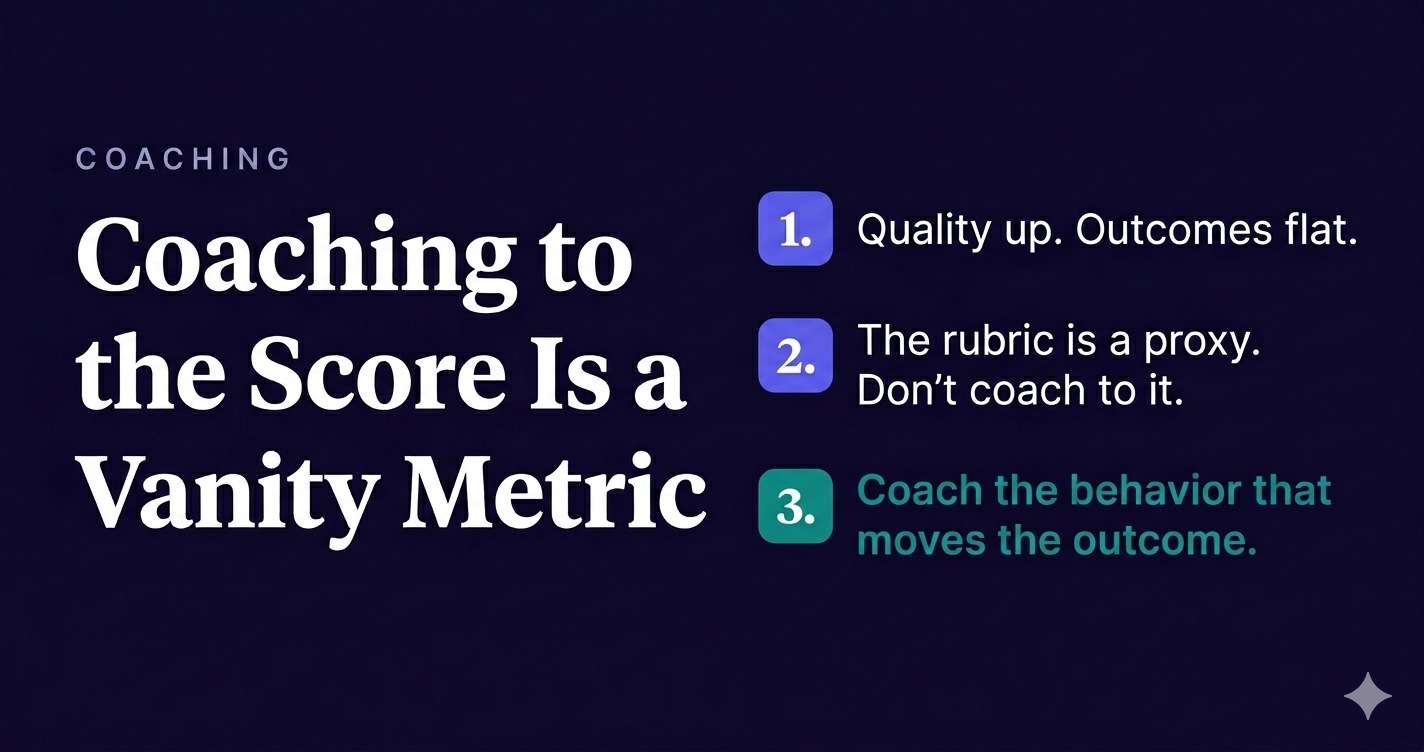
Most operators running a coaching program know the moment their quality score lifts. The reports tighten. The leadership review moves faster. The client-facing slide looks better than last quarter. Then the BPO loses seats anyway. Or CSAT drifts the other direction. Or conversion stays flat.
The score moved. The thing the score was supposed to predict did not. That gap is where most coaching programs quietly break, and the source is almost always the same. Coaches are coaching to the score, not to the behavior.
Coaching to the Score
The pattern is hard to see because it looks like good practice. The coach pulls the latest evaluations, finds the lowest-scoring criterion, and walks the agent through what the rubric wanted. Compliance failed. Probing was thin. The close ran short. The session is structured around the report. The agent leaves knowing exactly which boxes to check on the next batch of calls.
What this approach gets right is real. It is fast. It is defensible. It produces visible movement on the scorecard. It satisfies the QA reporting cadence the client signed up for.
Where it fails is also real, just less visible. The score moves because the agent learned to check boxes. The outcome does not move because the boxes are not the behaviors that decide whether the customer renews, converts, or hangs up satisfied. The rubric becomes the target. The rubric improves. Nothing underneath does.
This is the version of the coaching program that produces the BPO leadership review where quality is up nine points and the account is gone anyway. The client did not buy a quality score. They bought an outcome the score was supposed to predict.
Coaching to the Behavior
The other approach starts somewhere else. Not with the rubric. With the call. What did the agent actually do? Where did the customer get confused, push back, or quietly disengage? Which behavior, if changed, would have shifted that moment? The scorecard is still in the room. It is just downstream of the question, not in front of it.
An online travel agency we worked with rebuilt their program around this. They had a quality score. They wanted to figure out how to actually get better, not just how to score higher. So they reverse-engineered the scorecard. They asked which behaviors on a call actually affected the outcomes the client cared about. Conversion. Refunds. Cancellations. They built criteria around those behaviors. Then they tested the link directly.
The test was operational and simple. If quality improved and conversion stayed flat, refunds and cancellations had to drop. Otherwise the new criteria were not measuring the right behaviors. If conversion lifted, refunds could not climb with it. Otherwise the agents were converting customers who would not stick. The behaviors had to produce the outcome shift, or the criteria were the wrong criteria.
What this approach costs is real. It is slower. It is harder to defend in a leadership review than a clean QA percentage. The reporting cadence has to wait while the criteria get validated. The payoff is that the score becomes a real predictor again. Coaching is built around what changes the outcome, not what fills in the rubric.
Why This Is Not a Tie
The reason this is not a balanced choice is that the buyer of a coaching program is almost never paying for the score. They are paying for the outcome the score was supposed to predict. CSAT. Conversion. Renewal. Refund rate. Average handle time. Whatever the contract was actually written against. The scorecard is a proxy.
When the proxy moves and the underlying metric does not, the proxy has decoupled from the thing it was meant to measure. That is the definition of a vanity metric. Operators feel it when the QA report looks strong and the account still pulls headcount.
Most coaching programs pick the score-first approach because it is faster to defend up the chain and easier to staff. That is also why they keep losing accounts. The client does not buy quality scores. The client buys results.
FiveLumens was built around this gap. The scorecard exists. It just stops being the target that writes the coaching session, because the target is whatever moves the outcome.
A scorecard is a proxy. Coach to the proxy and the proxy improves. Coach to the conversation and the proxy and the outcome move together. The question is not whether your quality score is going up. The question is whether anything underneath it is.