
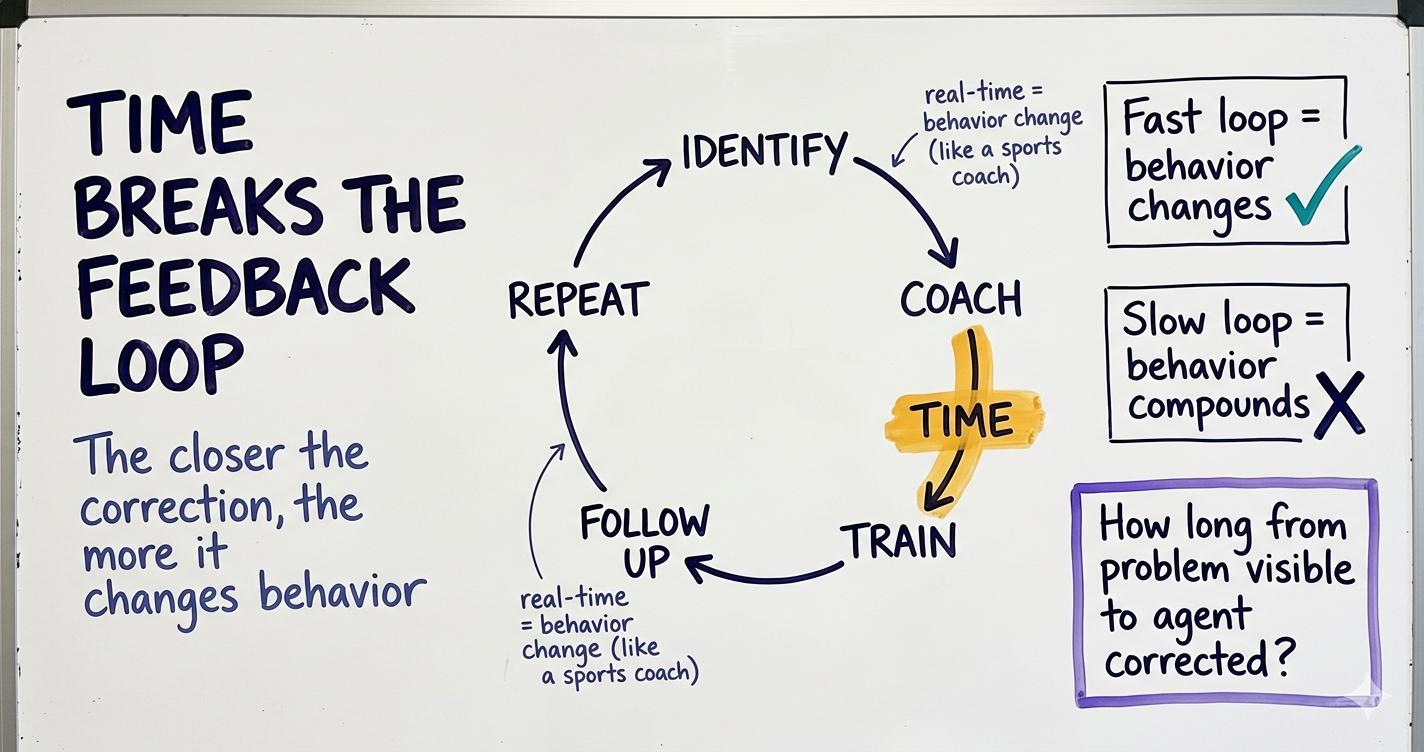
Most contact center leaders can see what is happening. The data is there. The reports run. The QA scores populate. The feedback loop is not broken at the insight layer. It breaks in the distance between noticing and doing something about it.
That distance is where performance goes to stall.
There are two places this shows up most consistently. The first is at the team level. Data gets reviewed in aggregate, which means enough of it has to accumulate before a pattern is visible. Then someone has to confirm the pattern is real. Then training has to design a response, get it approved, and roll it out. By the time agents receive the correction, weeks have passed. The behavior that caused the problem has had weeks to compound.
The second is at the individual level, and it is quieter. An agent is struggling. The manager notices and says they will listen to another call later in the week. Then an agent comes to that same manager after a hard call, frustrated, and asks for help. The manager pulls up the call when they have time, listens, tries to find time to sit down with the agent, and by then the moment is gone. The emotion that made the agent want to learn has passed. What was a live coaching opportunity became a scheduled conversation about something the agent barely remembers feeling.
This is the part most leaders miss when they review performance results. They look at whether feedback was given. They do not look at when.
Feedback loses potency the farther it travels from the event. This is not a contact center observation. It is how humans process and retain experience. The closer the correction is to the behavior, the more connected the person is to what happened, what it felt like, and what they want to do differently. An agent who had a hard call and comes to their manager is already primed. They are in it. That is the moment. A week later, the memory has softened. The correction lands on different ground.
Think about how coaching works in a sport. A player makes a mistake and the coach pulls them aside immediately, corrects the behavior, and puts them back in. The correction happens while the player still has the full sensory experience of the mistake. Behavior changes in real time because the feedback arrives in real time.
Contact center coaching rarely works that way. The systems that hold performance data, conversation recordings, and coaching workflows are often disconnected enough that speed is structurally impossible. A manager who wants to act quickly still has to navigate across tools to get there. By the time they do, the window has closed.
A functional feedback loop runs in one direction without stopping: identify, coach, train, follow up, begin again. Each step depends on the one before it completing quickly enough that the next step still matters. When the loop slows down anywhere, the steps that follow lose their effect.
FiveLumens is built around this problem. The platform connects the data layer to the coaching layer so that the time between identifying a gap and addressing it shrinks to where it can actually change behavior. The loop does not just exist. It moves.
The question worth asking is not whether your team has a feedback process. Most do. The question is how much time passes between when a problem is visible and when an agent receives a correction. That number tells you whether your loop is working.