
Most contact centers are measuring the wrong things and holding agents accountable for both of them.
NPS and CSAT are not the same metric and they do not have the same problem. Understanding the difference matters before you can fix either one.
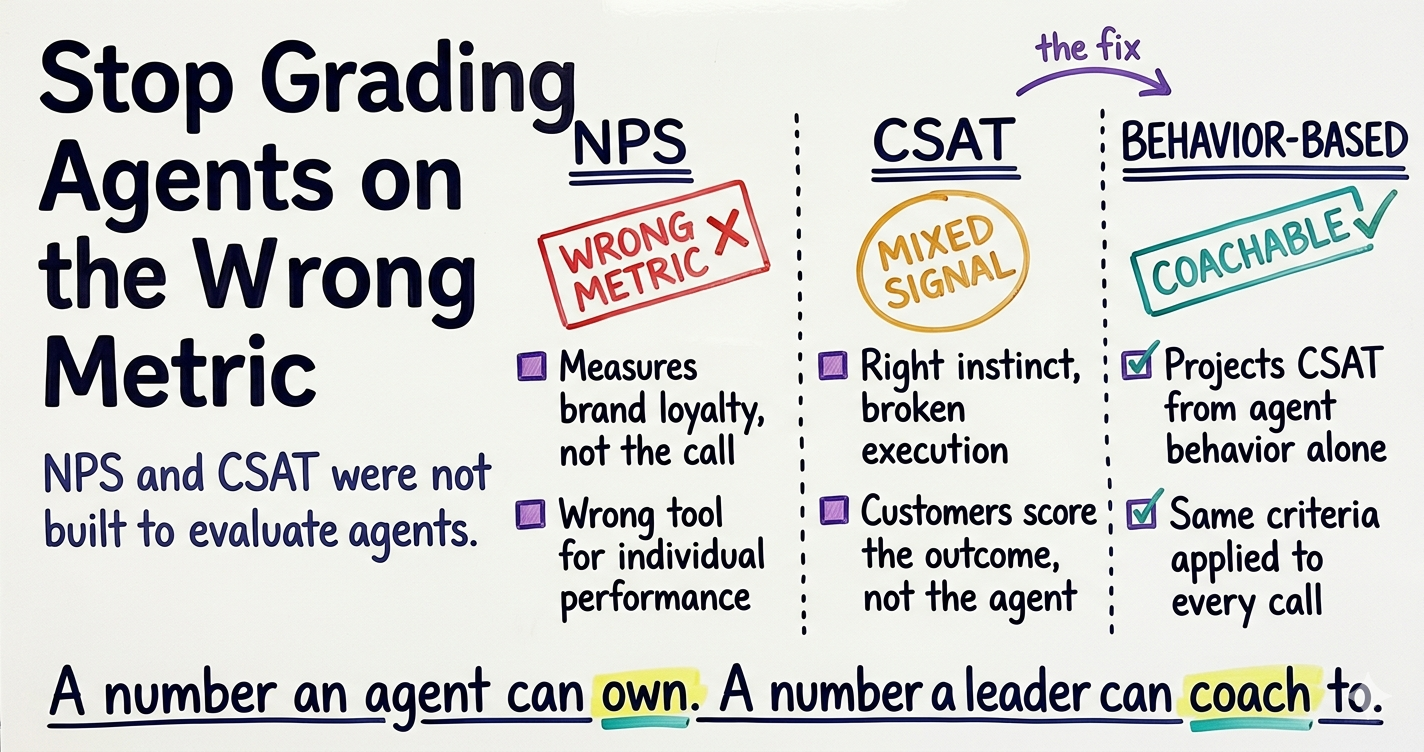
NPS measures customer loyalty toward your brand and product. It is a relationship metric. One question, answered on a 0 to 10 scale, telling you how likely a customer is to recommend your company to someone else.
It reflects how they feel about you overall, not what happened on a single call. Using it to evaluate individual agent performance was never the right application. It was not designed for that and it does not produce a signal that connects to what any agent did on any specific interaction.
CSAT is closer to the right tool. It is transactional, tied to a specific interaction, which is exactly what you need when evaluating agent performance.
The problem is that customers cannot separate the outcome from the interaction itself. A customer who called to dispute a charge and lost will score low. The agent may have been empathetic, clear, and professional throughout. None of that registers if the policy did not allow the exception.
The survey captures frustration with the result, not an assessment of the person who handled the call.
So NPS is the wrong metric entirely. CSAT is the right instinct with a fundamental execution problem. Leaders end up with two data sources, both unreliable for the purpose they are being used for, and a response rate that compounds the problem.
The surveys are not useless. NPS tells you something real about brand sentiment and product loyalty. Use it for product decisions and company strategy. CSAT tells you how customers felt about a specific interaction, filtered through whether they got what they wanted. That has value for identifying policy friction and systemic issues.
Neither tells you whether your agents are performing.
There is a different way to measure it. When you evaluate calls against scoring criteria built around actual agent behaviors and words, you can project what the CSAT score would look like based solely on what the agent did, completely isolated from the outcome.
You can also measure something more direct: whether the agent’s conduct alone, regardless of outcome, would make a customer want to work with that person again. Both are AI-produced scores applied consistently across every evaluated call, using the same criteria every time.
That is a number an agent can be held accountable for. That is a number a leader can coach to.
Stop using brand loyalty metrics to evaluate individual performance. Fix how you apply the transactional ones. And build a measurement system around what agents can actually control.
If you want to see what that looks like on your own calls, FiveLumens will evaluate 200 of them at no cost. You will see projected CSAT and agent experience scores built entirely around behavior, not outcome. Click the Request Demo button to get started.