
Most coaching sessions are just meetings with a nicer name.
The agent sits down. The manager runs through a list. The agent nods. Everyone moves on. Nothing changes.
That is not coaching. That is compliance theater.
We have seen coaching programs across every vertical in contact centers. The sessions that actually changed behavior had nothing in common with the ones that checked a box. The difference was not the manager’s personality or the agent’s attitude. It was the structure of the session itself.
Here is what separated them.
Preparation Before the Session
A checkbox meeting starts cold. The manager pulls a random call five minutes before, skims it, and walks in without a clear direction.
A real coaching session starts with preparation. The manager walks in with a specific, evidence-backed focus already selected. They know what behavior they are addressing and why it matters. They have examples ready. The agent can tell the difference immediately.
Preparation signals that the session is worth taking seriously. Without it, the agent knows this is just another box to check.
One Primary Focus, Not a List
Even when there are multiple issues, effective coaching requires choosing one primary topic. At most, one secondary.
Coaches who try to fix everything fix nothing. When you hand an agent a list of five things to improve, they leave the session overwhelmed and unclear on where to start. Nothing sticks.
One focus forces prioritization. It makes the session actionable. The agent leaves knowing exactly what to work on and why it was chosen over everything else.
The Agent Discovers the Answer
This is the hardest part. It requires a skilled manager who knows how to ask questions that lead the agent to the insight rather than delivering it to them.
If the solution is your idea, the agent has no ownership of it. They will nod, agree, and forget it by the next call. But if they arrive at the answer themselves, they own it. Commitment follows from agency, not instruction.
This is not about withholding information. It is about guiding the conversation so the agent connects the dots. When they say “I should have asked a follow-up question there” instead of hearing you say it, the lesson lands differently.
Not every manager can do this naturally. It is a skill that has to be developed. But it is the skill that separates coaching from lecturing.
Role Play to Prove Understanding
A checkbox meeting ends after the discussion. A real coaching session does not.
Role play is where the agent proves they can apply the skill, not just that they understood the conversation. Knowing is not the same as doing. You do not move on until they show you.
This is the step most managers skip because it feels awkward or time-consuming. But skipping it means you have no idea whether the session worked. You are hoping the agent figured it out. Hope is not a coaching strategy.
Role play lets you start and stop, correct in the moment, and run it again until the behavior is right. It turns a conversation into practice.
A Mutual Commitment with a Specific Follow-Up Time
At the end of the session, the agent commits — in their own words — to what they will do differently. Not a vague agreement. A specific behavior they will change.
But commitment is not one-sided. The manager also commits to a specific follow-up timeframe. “I will be back Thursday to listen to your calls and see how this is going.”
Without this, the session is a conversation with no close. The agent has no reason to believe anyone will check. And they are usually right.
Follow-Up Is the Session That Makes the First Session Matter
This is the most crucial step. It is also the most overlooked.
Behavior change is only real if someone comes back to observe it, reinforce it, or course-correct. No follow-up means no accountability loop. It means the coaching session was theater.
Follow-up is not optional. It is not “when I get time.” It happens within the timeframe you committed to. If the behavior improved, you reinforce it. If it did not, you coach again. Either way, the agent knows the session mattered.
The managers who skip follow-up are the same ones who wonder why their coaching never sticks. This is why.
The Bottom Line
Checkbox meetings feel productive. They fill a calendar slot. They generate documentation. But they do not change behavior.
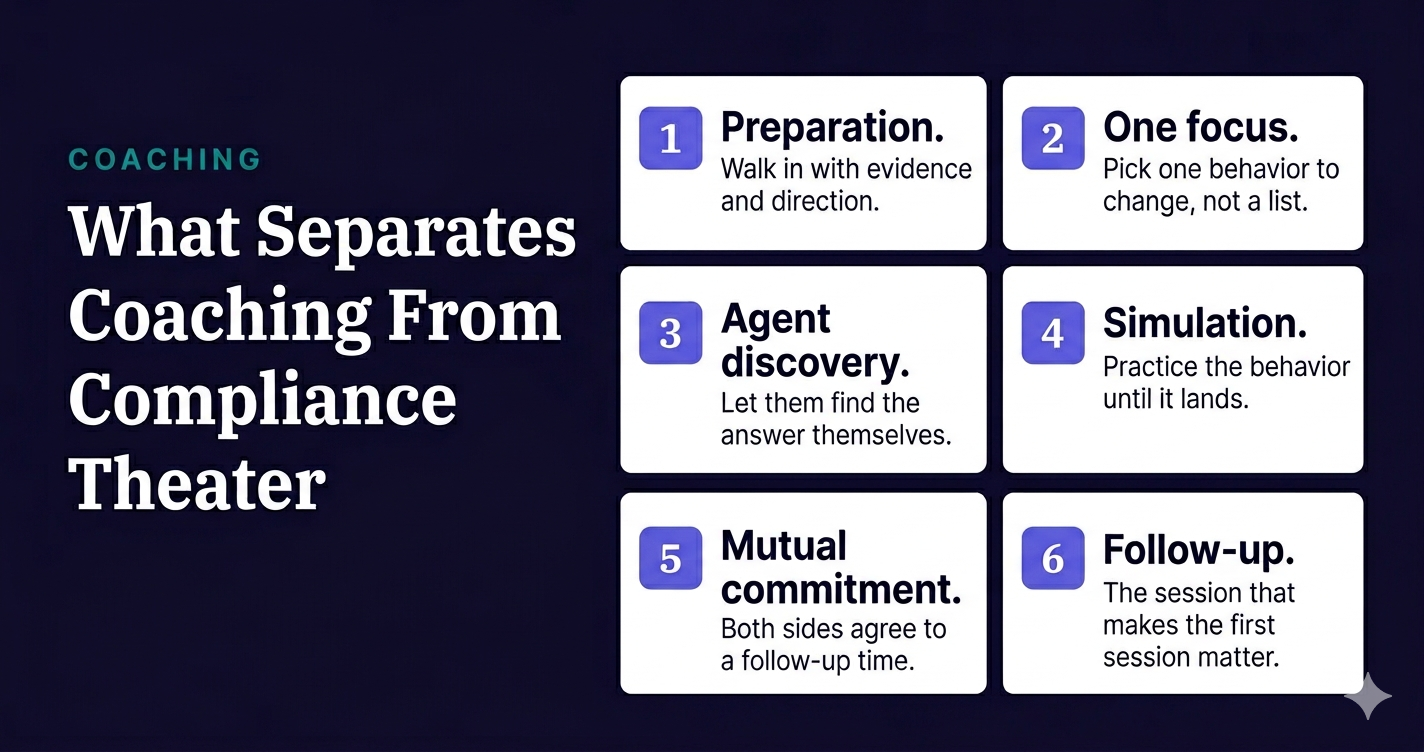
Real coaching requires preparation, focus, agent-driven discovery, role play, mutual commitment, and follow-up. Skip any one of these, and you are back to compliance theater.
The question is not whether you are holding coaching sessions. The question is whether your coaching sessions are actually coaching.